
Three Images from the Laguna Beach Coastal Photography Workshop
One of the most valuable parts of a photography workshop happens after the cameras are put away. Reviewing and discussing our images often reveals just as much about the photographic process as the time spent making them.
During the workshop, participants photographed from several Laguna Beach locations, including Heisler Park, Picnic Beach and Monument Point, while working through changing coastal light and weather conditions.
As a wrap-up to our Laguna Beach Coastal Photography Workshop, we ask each attendee to select three favorite photographs from the weekend and share them with the group. More importantly, we ask them to explain why they chose those images.
The goal is not to decide which photographs are technically perfect or which images everyone else likes best. It is to think about the decisions that went into making them.
What caught your attention?
Why did you choose that viewpoint?
What were you trying to accomplish with the composition?
How did the light or conditions affect your approach?
Would you make the photograph differently if you had another opportunity?
That process of selecting, reviewing, and explaining our images can be as valuable as making them.
So, just as we ask our attendees to do, I selected three photographs from the workshop that stood out to me.
Each one represents a different part of the photographic process: composition, adaptation, and timing.
Framed Coastline from Heisler Park
We began the workshop in Heisler Park, exploring the coastline from several elevated viewpoints before eventually working our way toward sea level.
From one overlook, the obvious photograph was the expansive view of the Laguna Beach coastline below. But instead of simply photographing the open view, I became interested in the trees and coastal vegetation immediately in front of me.
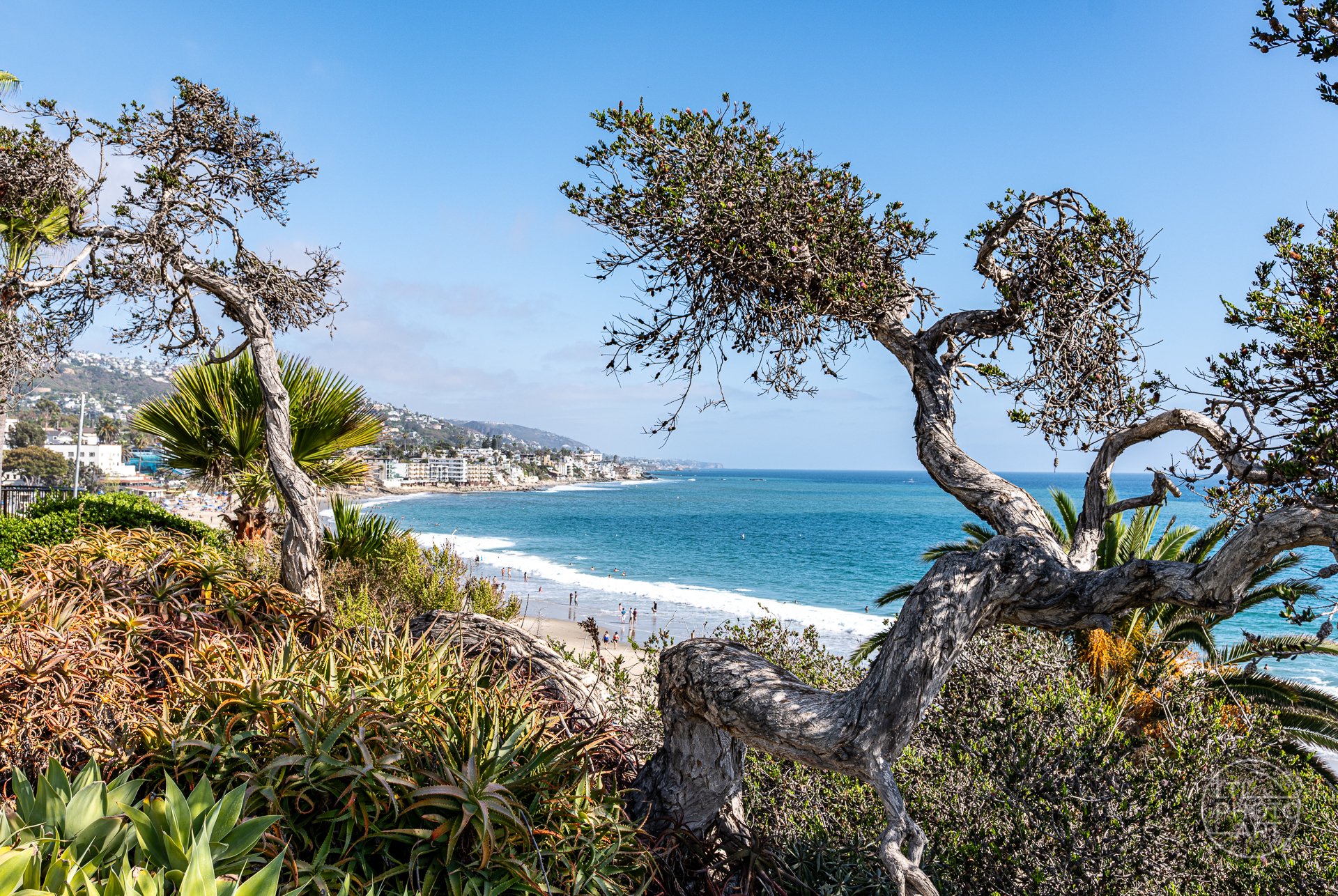
From an elevated viewpoint, foreground trees create a natural frame that guides the viewer through the beach, ocean, and distant coastline while adding depth to the scene.
I built the composition around those foreground elements.
The twisting trunks and branches created a natural opening toward the beach and ocean, while the elevated viewpoint helped separate the different layers of the scene. The vegetation establishes the foreground, the beach and water form the middle of the photograph, and the coastline carries the eye farther into the distance.
The photograph became less about simply showing Laguna Beach and more about how I wanted the viewer to experience the scene.
This is one of the ideas we emphasized throughout the workshop: foreground elements should have a purpose. They can create depth, establish scale, frame the subject, or help guide the viewer through the photograph.
Sometimes moving a few feet—or simply changing how you look at the foreground—can turn a straightforward scenic view into a much more deliberate composition.
Movement Around Monument Point
Later that afternoon, we moved to an elevated position above Monument Point to prepare for sunset.
Unfortunately, the clouds had other plans.
Most of the western sky remained covered, with only a narrow opening near the horizon. Rather than continuing to point the camera toward a sunset that was not developing the way I had hoped, I turned the tripod back toward Monument Point.
The rocks and moving water offered another possibility.
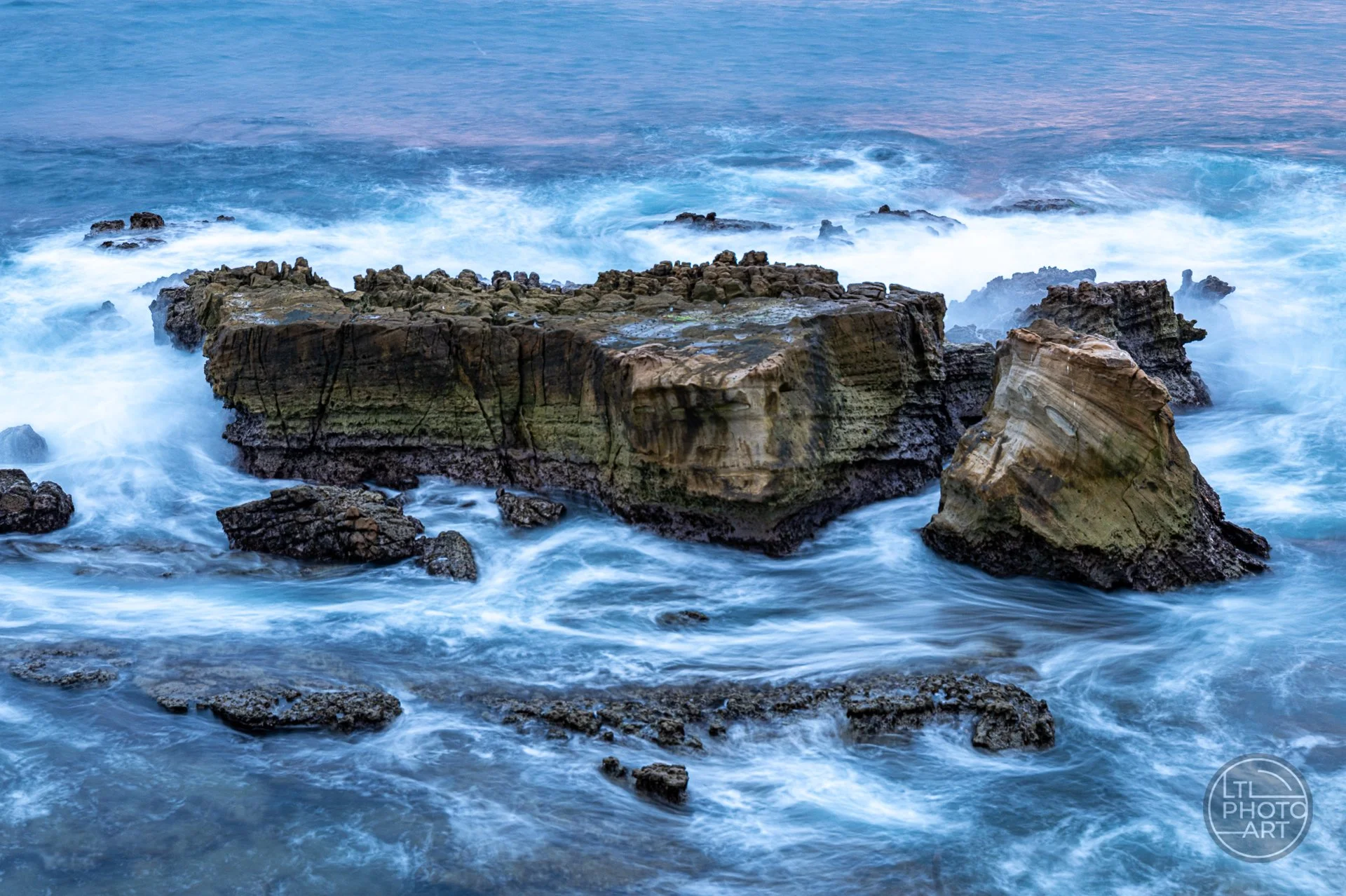
A 3-second exposure transforms the water into flowing patterns around the rocks, showing how changing direction and working with the available conditions can reveal a stronger composition.
I filled the frame with the rock formations and surrounding water rather than including a large amount of sky.
Using a 3-stop neutral density filter, I chose a 3-second exposure to allow the water to move through the frame. Because of the filter and fading light, I increased the ISO to 400 to achieve the exposure I wanted.
The longer shutter speed changed the role of the water.
Instead of freezing individual waves, the exposure recorded their movement as flowing patterns around the rocks. The solid formations provide structure while the water creates motion between and around them.
Near the top of the image, a subtle reddish-pink band remained from the sunset. It was not enough to make the sunset itself the subject, but it added just enough color to complement the cooler tones in the water.
This photograph is a good reminder of something that happens frequently in landscape photography: the photograph you planned may not be the photograph the conditions give you.
When that happens, look around.
Turn around.
Change lenses.
Change shutter speeds.
Look for what the scene is actually offering rather than waiting indefinitely for what you hoped it would become.
Sunset Rays at Monument Point
By the time we worked our way back down to sea level at Monument Point, the day had been mostly overcast.
There had been occasional periods of sunlight, but the conditions had led me to spend much of the afternoon thinking in black and white. The textures in the rocks, water, and clouds seemed particularly well suited to a monochrome approach.
Then, near sunset, the clouds began to open.
Sunlight broke through in distinct rays over the Pacific.
That became the photograph.
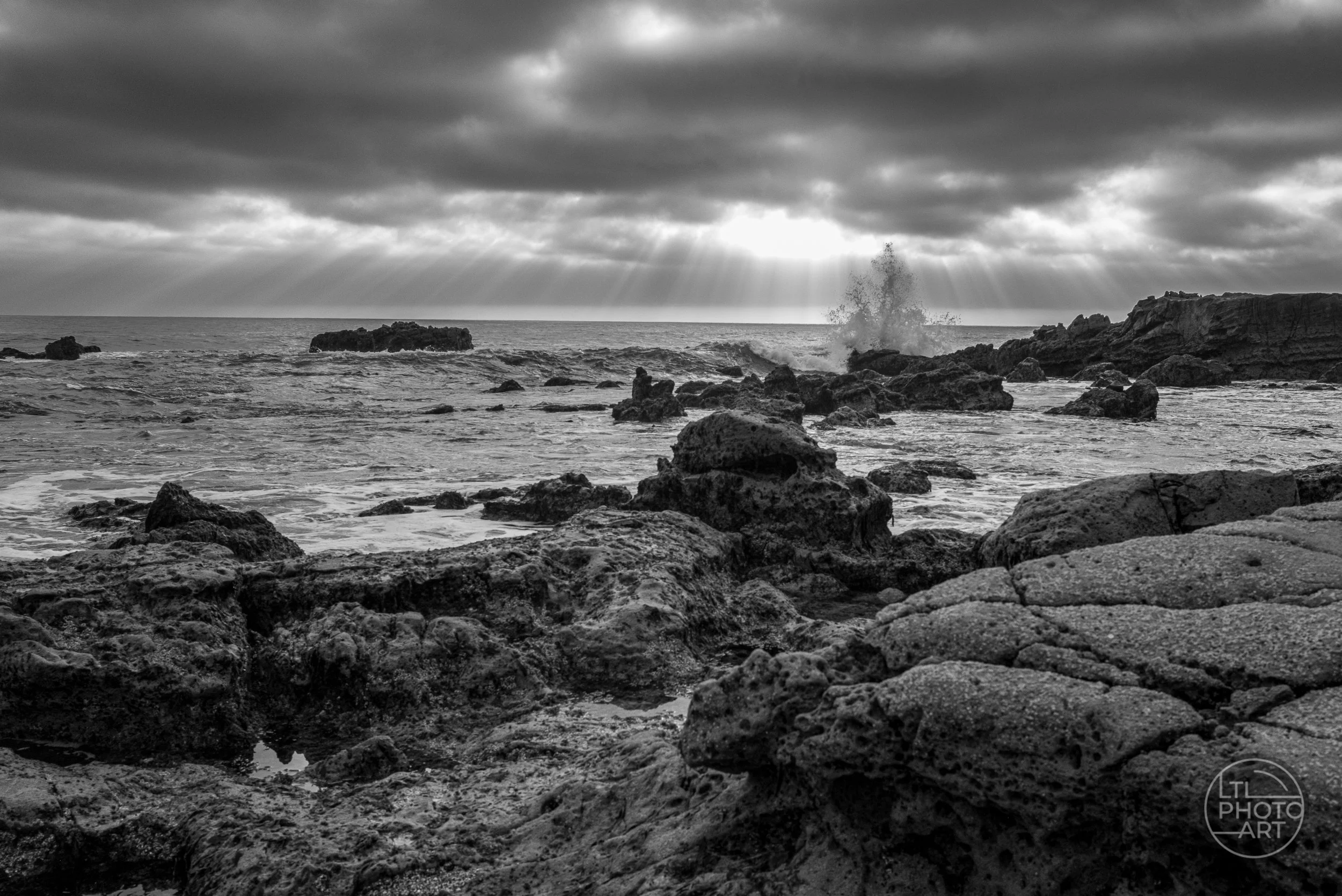
Sunrays breaking through heavy clouds become the primary subject, while a well-timed wave splash adds energy and balance near the upper-right third of the frame.
I composed around the light first.
The sunrays were clearly the main subject, so I established the composition and then watched what was happening throughout the rest of the frame.
That is when the second element came together.
A wave struck the rocks in the distance and sent a burst of spray into the air. The splash appeared near the upper-right intersection of the rule of thirds, giving the photograph another point of interest while balancing the brighter light toward the center of the composition.
The wave splash was not something I could control. But I could control the composition, and I could wait.
That distinction is important in coastal photography. Once you establish a composition, sometimes the best thing you can do is stay with it and allow the ocean to provide the moment.
A second earlier, the splash was not there.
A second later, it was gone.
Three Photographs, Three Different Decisions
Looking at these three photographs together, what interests me most is that none of them came from exactly the same approach.
The Heisler Park image began with composition—using foreground elements and an elevated viewpoint to create depth and guide the viewer through the photograph.
The long exposure at Monument Point came from adaptation—recognizing that the expected sunset was not developing and finding another photograph in the movement of the water around the rocks.
The black-and-white image came down to timing—establishing the composition around the sunrays and waiting for the ocean to add the right moment.
That is one of the reasons we ask our workshop attendees to select three photographs rather than simply choosing a single favorite.
Three images begin to reveal patterns.
They show what attracted your attention, how you approached different conditions, and what decisions you made before pressing the shutter.
The Photograph Is Only Part of the Process
Photography does not end when we press the shutter.
Reviewing our work helps us understand why some photographs succeed and why others do not.
Explaining a photograph forces us to think beyond whether we simply “like” the image.
Why does it work?
Where does your eye go first?
What role does the foreground play?
Did the shutter speed contribute to the photograph?
Did you respond to the conditions, or were you still trying to make the photograph you originally envisioned?
Those are the kinds of questions we want our attendees thinking about when they present their three images.
And they are questions I continue to ask myself.
The goal is not just to return from a workshop with more photographs.
It is to return seeing a little differently.