
Working the Scene: Why Your First Composition Is Rarely the Best
A compelling photograph rarely happens by accident. More often, it is the result of observation, patience, and intentional choices about what belongs in the frame—and what does not.
One of the most common habits photographers develop is spotting an attractive scene, raising the camera, taking a quick photograph, and moving on. While that first image may capture the moment, it is often only the beginning of the creative process.
The strongest photograph is frequently discovered after you slow down and begin to work the scene.
The First Frame Is a Starting Point
When a scene catches your eye, something has already drawn you in. It may be the quality of the light, the rhythm of the waves, the shape of the shoreline, the texture of weathered rocks, or the movement of clouds overhead.
The first photograph helps identify what attracted you to the scene, but it is rarely the final answer. More often, it is a visual note—a starting point for exploration. Before moving on, pause and ask yourself:
What is the true subject?
What supports the photograph?
What distracts from it?
Would a different perspective create a stronger composition?
Should I move closer, step back, lower the camera, or wait?
These questions shift your mindset from simply recording a place to intentionally creating an image.
Slow Down and Stay with the Scene
Photography rewards patience.
Nowhere is this more evident than along the coast, where conditions are constantly changing. Light evolves. Waves rise and fall. Water swirls around rocks. Clouds drift across the sky. Reflections appear and disappear in moments.
If you leave too quickly, you may miss the photograph that inspired you to stop in the first place.
Remaining with a scene allows you to study its rhythm. Watch the waves. Follow the light. Examine the foreground and background. Notice how lines, shapes, textures, and negative space interact.
Often, the strongest image appears several minutes—or even much longer—after the first frame.
Change Your Perspective
One of the simplest ways to improve a composition is to physically change your position.
After capturing the initial image, try something different:
Move left or right
Step closer
Back away
Lower your camera
Find a higher vantage point
Rotate slightly
Reframe the subject
Small adjustments can transform a photograph. A distraction may disappear. A leading line may become more prominent. Foreground elements may create greater depth and connection.
Composition is not determined solely by what you see—it is shaped by where you choose to stand.
Explore Wide and Intimate Views
A successful scene often contains more than one photograph.
The wide composition may reveal the grandeur of the landscape—shoreline, cliffs, ocean, and sky working together. Yet within that larger view may be a more intimate image waiting to be discovered. Look for details:
Water flowing through rocks
Patterns in sea foam
Reflections in a tide pool
Light illuminating a single subject
Textures shaped by wind and water
Begin with the expansive view, then search for smaller stories within it. Simplifying the composition often reveals photographs that might otherwise be overlooked.
Sometimes the most memorable image is hidden inside the larger scene.
Turn the Camera Vertical
Landscape photographers often gravitate toward horizontal compositions, and for good reason. Coastlines, horizons, and sweeping views naturally lend themselves to a wider frame.
But vertical compositions deserve equal consideration.
A portrait orientation can emphasize depth, movement, and visual flow. It can carry the viewer from foreground rocks, through breaking waves, and into the sky above. It often creates a stronger sense of immersion and can reveal relationships within the scene that are less obvious in a horizontal frame.
When working a scene, challenge yourself to create both. A simple turn of the camera may reveal an entirely different photograph.
Wait for the Moment
A beautiful location does not always produce an immediate photograph.
Along the coast, timing matters.
The wave may not have broken yet. The water may need to recede. Light may need to reach the rocks. A cloud may need to move into position. A bird, surfer, or passing figure may provide the perfect sense of scale.
Working the scene often means waiting for the elements to come together. Stay with the composition. Observe. Anticipate. Be ready when the light, movement, and timing align.
At Monument Point, a single set of waves can create several different photographs from nearly the same composition. One moment may be filled with impact and spray; a few seconds later, the same rocks may be covered with flowing water, texture, and quiet movement.
The two images below were photographed from the same position at Monument Point as a set of waves moved through the scene. The framing stayed nearly the same, but the timing created two very different photographs.

A breaking wave brings energy, motion, and drama to the same Monument Point composition, showing how timing can completely change the feeling of a coastal photograph.
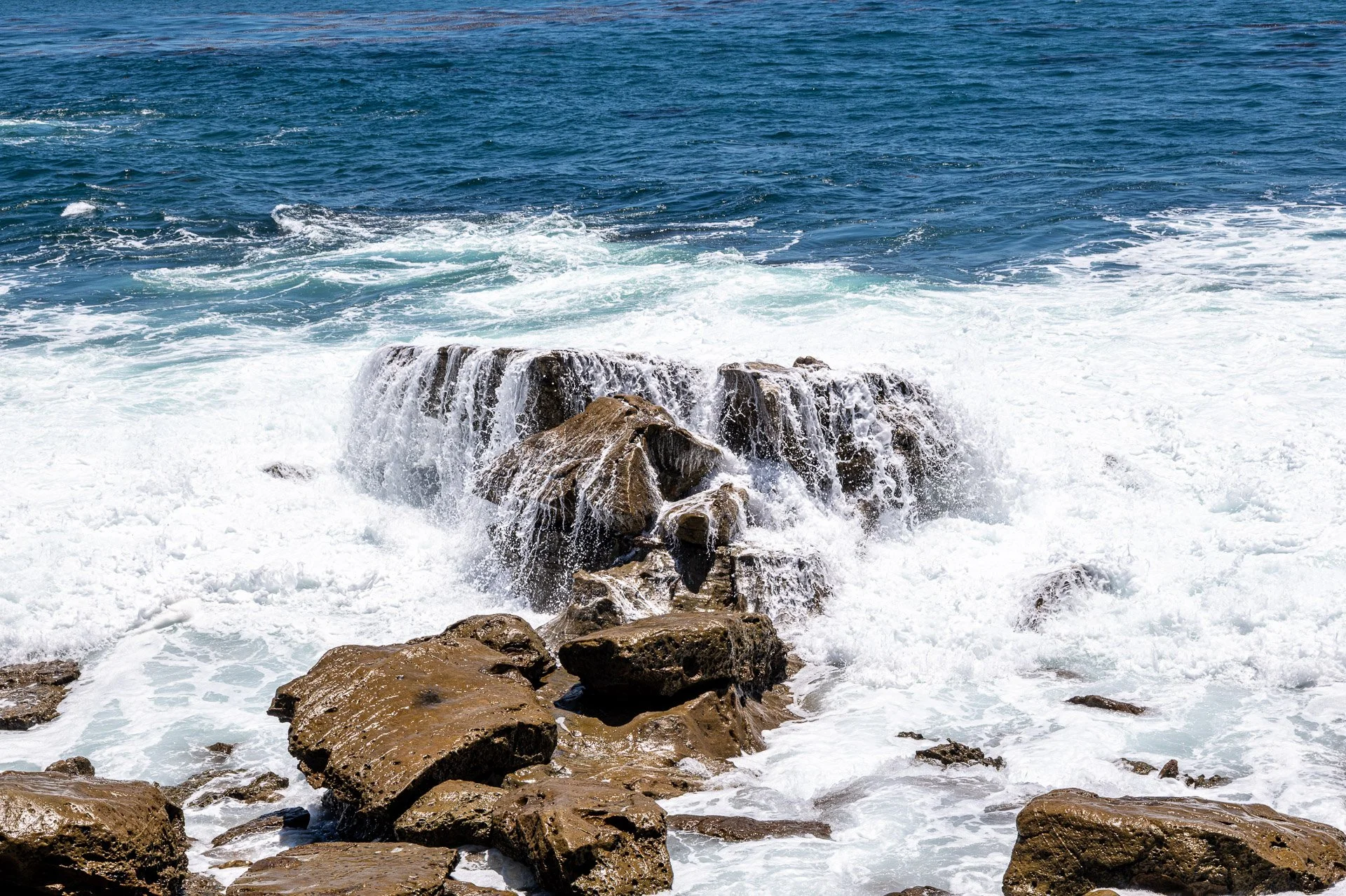
Moments later, the scene becomes quieter as water cascades over the rocks, creating texture, flow, and detail.
Same scene, different moment: at Monument Point, a few seconds can change the entire feeling of a coastal photograph — from the energy of a breaking wave to the quieter texture of water cascading over the rocks.
Patience frequently separates a good photograph from a memorable one.
Pay Attention to the Edges
One of the most effective ways to strengthen a photograph is to examine the edges of the frame before pressing the shutter.
The subject may be compelling, yet small distractions around the perimeter can pull attention away from what matters most. Before taking the photograph, scan:
The top edge
The bottom edge
The left side
The right side
Look for bright distractions, awkward cutoffs, empty corners, or competing elements. If something weakens the composition, adjust your position or refine the framing.
A clean frame helps the viewer connect with the intended subject.
Practicing Along the Laguna Beach Coast
Laguna Beach provides an ideal environment for learning how to work a scene.
From Heisler Park and Divers Cove to Rockpile Beach, Monument Point, and the surrounding coastline, photographers can explore a remarkable variety of subjects within a relatively small area.
A single location may offer expansive ocean vistas, dramatic shoreline curves, tide pools, textured rocks, reflections, surfers, wildlife, or changing patterns of light across the water.
The diversity of opportunities naturally encourages photographers to slow down, experiment, and see beyond the obvious first composition.
This is one of the core lessons we emphasize during the Laguna Beach Coastal Photography Workshop—learning to observe with intention, refine perspective, simplify compositions, and recognize when the best image is still waiting to emerge.
The first frame matters because it begins the process. The strongest image often appears after you continue exploring the possibilities.
Final Thoughts
The next time a scene captures your attention, take the photograph—but do not stop there.
Stay with it. Move. Observe. Reframe. Explore different focal lengths. Try horizontal and vertical compositions. Watch the light. Study the edges. Wait for the moment.
The first image shows what caught your eye.
The best image is often the one you discover after you begin working the scene.
Laguna Beach Coast Photography Workshop
Many of these principles come to life during the Laguna Beach Coastal Photography Workshop, where photographers learn to see beyond the obvious composition and develop a more thoughtful approach to coastal photography.
Together, we explore how light, perspective, timing, patience, and small changes in position can dramatically transform an image.
Because the most rewarding photographs are rarely found in the first frame.
They are discovered by photographers willing to slow down, stay curious, and keep looking.
Learn more about the Laguna Beach Coastal Photography Workshop and upcoming dates.